
Data Protection
Table of Contents
-
Introduction and overview
-
scope of application
-
legal bases
-
storage duration
-
Rights under the General Data Protection Regulation
-
security of data processing
-
communication
-
web hosting
-
Messenger & Communication
-
External online platforms
-
payment provider
-
Facebook Privacy Policy
Introduction and overview
We have written this data protection declaration (version 01.12.2021-311891767) in order to provide you with information in accordance with the requirements of General Data Protection Regulation (EU) 2016/679 and applicable national laws to explain which personal data (data for short) we as the responsible party – and the processors commissioned by us (e.g. providers) – process, will process in the future and what legal options you have. The terms used are to be understood as gender-neutral.
In a nutshell: We inform you comprehensively about data that we process about you.
Privacy statements usually sound very technical and use legal jargon. This data protection declaration, on the other hand, is intended to describe the most important things as simply and transparently as possible. As far as it is conducive to transparency, technical Terms explained in a reader-friendly way Left offered for further information and graphics put to use. We are thus informing you in clear and simple language that we only process personal data in the course of our business activities if there is a corresponding legal basis. This is certainly not possible if you make the most concise, unclear and legal-technical statements possible, as they are often standard on the Internet when it comes to data protection. I hope that you find the following explanations interesting and informative and that you may find some information that you did not already know.
If you still have questions, we would like to ask you to contact the responsible person named below or in the imprint, to follow the links provided and to look at further information on third-party websites. Our contact details can of course also be found in the imprint.
scope of application
This data protection declaration applies to all personal data processed by us in the company and to all personal data that companies commissioned by us (processors) process. By personal data we mean information within the meaning of Art. 4 No. 1 GDPR such as a person’s name, e-mail address and postal address. The processing of personal data ensures that we can offer and bill our services and products, whether online or offline. The scope of this privacy policy includes:
-
all online presences (websites, online shops) that we operate
-
Social media appearances and email communication
-
mobile apps for smartphones and other devices
In a nutshell: The data protection declaration applies to all areas in which personal data is processed in a structured manner in the company via the channels mentioned. If we enter into legal relationships with you outside of these channels, we will inform you separately if necessary.
legal bases
In the following data protection declaration, we provide you with transparent information on the legal principles and regulations, i.e. the legal basis of the General Data Protection Regulation, which enable us to process personal data.
As far as EU law is concerned, we refer to REGULATION (EU) 2016/679 OF THE EUROPEAN PARLIAMENT AND OF THE COUNCIL of April 27, 2016. You can of course read this EU General Data Protection Regulation online on EUR-Lex, the gateway to EU law, at https://eur-lex.europa.eu/legal-content/DE/TXT/?uri=celex%3A32016R0679 read.
We only process your data if at least one of the following conditions applies:
-
consent (Article 6 paragraph 1 lit. a GDPR): You have given us your consent to process data for a specific purpose. An example would be the storage of the data you enter on a contact form.
-
contract (Article 6 paragraph 1 lit. b GDPR): In order to fulfill a contract or pre-contractual obligations with you, we process your data. For example, if we conclude a sales contract with you, we need personal information in advance.
-
Legal Obligation (Article 6 paragraph 1 lit. c GDPR): If we are subject to a legal obligation, we process your data. For example, we are required by law to keep invoices for bookkeeping. These usually contain personal data.
-
Legitimate Interests (Article 6 paragraph 1 lit. f GDPR): In the case of legitimate interests that do not restrict your fundamental rights, we reserve the right to process personal data. For example, we need to process certain data in order to be able to operate our website securely and economically. This processing is therefore a legitimate interest.
Other conditions such as the perception of recordings in the public interest and the exercise of official authority as well as the protection of vital interests do not usually apply to us. Insofar as such a legal basis should be relevant, it will be indicated in the appropriate place.
In addition to the EU regulation, national laws also apply:
-
In Austria this is the federal law for the protection of natural persons with regard to the processing of personal data ( Data Protection Act ), in short DSG .
-
In Germany is that valid Federal Data Protection Act , short BDSG .
If other regional or national laws apply, we will inform you about them in the following sections.
storage duration
The fact that we only store personal data for as long as is absolutely necessary for the provision of our services and products is a general criterion for us. This means that we delete personal data as soon as the reason for the data processing no longer exists. In some cases, we are legally obliged to store certain data even after the original purpose has ceased to exist, for example for accounting purposes.
If you wish your data to be deleted or revoke your consent to data processing, the data will be deleted as quickly as possible and provided there is no obligation to store it.
We will inform you below about the specific duration of the respective data processing, provided that we have further information on this.
Rights under the General Data Protection Regulation
According to Article 13 GDPR, you have the following rights to ensure that data is processed fairly and transparently:
-
According to Article 15 GDPR, you have a right to information as to whether we are processing your data. If this is the case, you have the right to receive a copy of the data and to be informed of the following information:
-
for what purpose we carry out the processing;
-
the categories, i.e. the types of data that are processed;
-
who receives this data and if the data is transferred to third countries, how security can be guaranteed;
-
how long the data is stored;
-
the existence of the right to rectification, erasure or restriction of processing and the right to object to processing;
-
that you can complain to a supervisory authority (links to these authorities can be found below);
-
the origin of the data if we did not collect it from you;
-
whether profiling is carried out, i.e. whether data is automatically evaluated in order to create a personal profile for you.
-
-
According to Article 16 GDPR, you have the right to have the data corrected, which means that we must correct data if you find any errors.
-
According to Article 17 GDPR, you have the right to erasure (“right to be forgotten”), which specifically means that you can request the erasure of your data.
-
According to Article 18 GDPR, you have the right to restrict processing, which means that we may only store the data but not use it any further.
-
According to Article 19 GDPR, you have the right to data portability, which means that we can provide you with your data in a common format upon request.
-
According to Article 21 GDPR, you have a right of objection, which, after enforcement, will result in a change in processing.
-
If the processing of your data is based on Article 6 para. 1 lit. e (public interest, exercise of official authority) or Article 6 para. 1 lit. f (legitimate interest), you can object to the processing. We will then check as quickly as possible whether we can legally comply with this objection.
-
If data is used to operate direct advertising, you can object to this type of data processing at any time. We may no longer use your data for direct marketing after this.
-
If data is used to operate profiling, you can object to this type of data processing at any time. We may no longer use your data for profiling after this.
-
-
According to Article 22 GDPR, you may have the right not to be subject to a decision based solely on automated processing (e.g. profiling).
In a nutshell: You have rights – do not hesitate to contact the responsible person listed above!
If you believe that the processing of your data violates data protection law or your data protection rights have been violated in any other way, you can complain to the supervisory authority. This is the data protection authority for Austria, whose website you can find at https://www.dsb.gv.at/ Find. In Germany there is a data protection officer for each federal state. For more information you can contact the Federal Commissioner for Data Protection and Freedom of Information (BfDI) turn. The following local data protection authority is responsible for our company:
security of data processing
In order to protect personal data, we have implemented both technical and organizational measures. Where possible, we encrypt or pseudonymise personal data. In this way, we make it as difficult as possible for third parties to infer personal information from our data.
Art. 25 GDPR speaks here of “data protection through technology design and through data protection-friendly default settings” and means that one always thinks of security and corresponding security both with software (e.g. forms) and hardware (e.g. access to the server room). measures. If necessary, we will go into specific measures below.
communication
communication summary? Affected: Anyone who communicates with us by phone, email or online form? Processed data: e.g. B. Telephone number, name, e-mail address, entered form data. More details can be found under the type of contact used? Purpose: Handling of communication with customers, business partners, etc.? Duration of storage: Duration of the business case and the legal regulations⚖️ Legal basis: Art. 6 para. 1 lit. a GDPR (consent), Art. 6 para. 1 lit. b GDPR (contract), Art. 6 para. 1 lit. f GDPR (legitimate interests) |
If you contact us and communicate by telephone, e-mail or online form, personal data may be processed.
The data will be processed for the handling and processing of your question and the related business transaction. The data is stored for as long as the law requires.
Affected people
All those who seek contact with us via the communication channels provided by us are affected by the processes mentioned.
phone
If you call us, the call data will be stored pseudonymously on the respective end device and with the telecommunications provider used. In addition, data such as name and telephone number can then be sent by e-mail and saved to answer enquiries. The data will be deleted as soon as the business case has ended and legal requirements permit.
If you communicate with us by e-mail, data may be stored on the respective end device (computer, laptop, smartphone,…) and data is stored on the e-mail server. The data will be deleted as soon as the business case has ended and legal requirements permit.
online forms
If you communicate with us using an online form, data will be stored on our web server and, if necessary, forwarded to an e-mail address from us. The data will be deleted as soon as the business case has ended and legal requirements permit.
legal bases
The processing of the data is based on the following legal bases:
-
Art. 6 para. 1 lit. a GDPR (consent): You give us your consent to store your data and to continue to use it for business purposes;
-
Art. 6 para. 1 lit. b GDPR (contract): There is a need to fulfill a contract with you or a processor such as B. the telephone provider or we need the data for pre-contractual activities, such. B. the preparation of an offer, process;
-
Art. 6 para. 1 lit. f GDPR (legitimate interests): We want to conduct customer inquiries and business communication in a professional framework. These are certain technical facilities such. E-mail programs, exchange servers and mobile phone operators are necessary in order to be able to communicate efficiently.
web hosting
Web Hosting Summary? Affected: Visitors to the website? Purpose: professional website hosting and operation security? Processed data: IP address, time of website visit, browser used and other data. More details can be found below or from the web hosting provider used.? Duration of storage: depends on the respective provider, but usually 2 weeks⚖️ Legal basis: Art. 6 para. 1 lit.f GDPR (legitimate interests) |
What is web hosting?
When you visit websites today, certain information – including personal data – is automatically created and stored, including on this website. This data should be processed as sparingly as possible and only with justification. By the way, by website we mean the entirety of all web pages on a domain, ie everything from the start page (home page) to the very last sub-page (like this one). By domain we mean, for example, example.de or example.com.
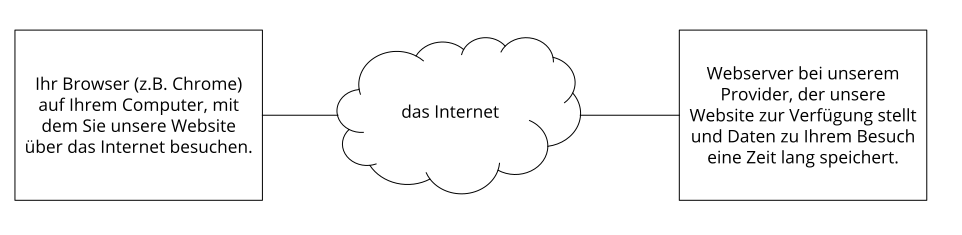
When you want to view a website on a screen, you use a program called a web browser. You probably know a few web browsers by name: Google Chrome, Microsoft Edge, Mozilla Firefox, and Apple Safari.
This web browser needs to connect to another computer where the website’s code is stored: the web server. The operation of a web server is a complicated and time-consuming task, which is why this is usually taken on by professional providers, the providers. These offer web hosting and thus ensure reliable and error-free storage of website data.
Personal data may be processed when the browser on your computer (desktop, laptop, smartphone) connects and during data transfer to and from the web server. On the one hand, your computer stores data, on the other hand, the web server also has to store data for a period of time in order to ensure proper operation.
As an illustration:
Why do we process personal data?
The purposes of data processing are:
-
Professional website hosting and operation security
-
to maintain operational and IT security
-
Anonymous evaluation of access behavior to improve our offer and, if necessary, for criminal prosecution or the pursuit of claims
Which data are processed?
Even while you are visiting our website, our web server, which is the computer on which this website is stored, usually automatically saves data such as
-
the complete internet address (URL) of the accessed website (e.g. B. https://www.beispielwebsite.de/beispielunterseite.html?tid=311891767)
-
Browser and browser version (e.g. Chrome 87)
-
the operating system used (e.g. Windows 10)
-
the address (URL) of the previously visited page (referrer URL) (e.g. B. https://www.beispielquellsite.de/vondabinichkommen.html/)
-
the hostname and IP address of the device being accessed from (e.g. COMPUTERNAME and 194.23.43.121)
-
Date and Time
-
in files, the so-called web server log files
How long is data stored?
As a rule, the above data is stored for two weeks and then automatically deleted. We do not pass on this data, but we cannot rule out that this data will be viewed by authorities in the event of illegal behavior.
In a nutshell: Your visit will be logged by our provider (company that runs our website on special computers (servers)), but we will not pass on your data without your consent!
legal basis
The legality of the processing of personal data in the context of web hosting results from Art. 6 para. 1 lit. f DSGVO (protection of legitimate interests), because the use of professional hosting with a provider is necessary in order to present the company on the Internet in a secure and user-friendly manner and to be able to pursue attacks and claims from this if necessary.
There is usually a contract between us and the hosting provider for order processing in accordance with Art. 28 f. GDPR, which ensures compliance with data protection and guarantees data security.
Messenger & Communication
Messenger & Communication Privacy Policy Summary? Affected: Visitors to the website? Purpose: Contact requests and general communications between us and you? Processed data: Data such as name, address, email address, telephone number, general content data, IP address if applicableYou can find more details on this under the respective tools used.? Storage duration: depends on the messenger & communication functions used⚖️ Legal basis: Art. 6 para. 1 lit. a GDPR (consent), Art. 6 para. 1 lit. f GDPR (legitimate interests), Art. 6 para. 1 p. 1 lit. b. GDPR (contractual or pre-contractual obligations) |
What are messenger & communication functions?
We offer various options on our website (e.g. messenger and chat functions, online form, e-mail, telephone or social media) to communicate with us. Your data will also be processed and stored insofar as it is necessary to answer your inquiry and our subsequent measures.
In addition to classic means of communication such as e-mail, contact forms or telephone, we also use chats or messengers. The most commonly used messenger function at the moment is WhatsApp, but of course there are many different providers who offer messenger functions especially for websites. If content is end-to-end encrypted, this is indicated in the individual data protection texts or in the data protection declaration of the respective provider. End-to-end encryption means nothing other than that the content of a message is not visible to the provider itself. However, information about your device, location settings and other technical data can still be processed and stored.
Why do we use messenger & communication functions?
The ability to communicate with you is very important to us. After all, we want to talk to you and answer all possible questions about our service in the best possible way. Well-functioning communication is an important part of our service. With the practical messenger & communication functions, you can always choose the ones you like best. In exceptional cases, however, it can also happen that we do not answer certain questions via chat or messenger. This is the case when it comes to internal contractual matters, for example. Here we recommend other communication options such as e-mail or telephone.
We generally assume that we remain responsible under data protection law, even if we use the services of a social media platform. However, the European Court of Justice has decided that in certain cases the operator of the social media platform can be jointly responsible with us within the meaning of Art. 26 DSGVO. If this is the case, we will point this out separately and work on the basis of a relevant agreement. The essence of the agreement is reproduced below for the platform concerned.
Please note that when using our built-in elements, your data may also be processed outside the European Union, since many providers, such as Facebook Messenger or WhatsApp, are American companies. As a result, you may not be able to claim or enforce your rights in relation to your personal data as easily.
Which data are processed?
Exactly which data is stored and processed depends on the respective provider of the messenger and communication functions. Basically, it is data such as name, address, telephone number, e-mail address and content data such as all information that you enter in a contact form. In most cases, information about your device and the IP address is also stored. Data that is collected via a messenger & communication function is also stored on the providers’ servers.
If you want to know exactly which data is stored and processed by the respective providers and how you can object to the data processing, you should carefully read the respective data protection declaration of the company.
How long is data stored?
How long the data is processed and stored depends primarily on the tools we use. Below you can find out more about the data processing of the individual tools. The data protection declarations of the providers usually state exactly which data is stored and processed for how long. In principle, personal data is only processed for as long as is necessary to provide our services. When data is stored in cookies, the storage period varies greatly. The data can be deleted immediately after leaving a website, but they can also be stored for several years. Therefore, you should look at each individual cookie in detail if you want to know more about data storage. In most cases you will also find informative information about the individual cookies in the data protection declarations of the individual providers.
Right to object
You also have the right and the option to revoke your consent to the use of cookies or third-party providers at any time. This works either via our cookie management tool or via other opt-out functions. For example, you can also prevent data collection by cookies by managing, deactivating or deleting the cookies in your browser. For more information, we refer to the consent section.
Since cookies can be used for messenger and communication functions, we also recommend our general data protection declaration on cookies. To find out exactly which of your data is stored and processed, you should read the data protection declarations of the respective tools.
legal basis
If you have agreed that your data can be processed and stored by integrated messenger and communication functions, this consent is the legal basis for data processing (Art. 6 Para. 1 lit. a GDPR) . We process your request and manage your data within the framework of contractual or pre-contractual relationships in order to fulfill our pre-contractual and contractual obligations or to answer inquiries. basis for it is Art. 6 para. 1 p. 1 lit. b. GDPR. In principle, your data will also be processed on the basis of our legitimate interest if you have given your consent (Art. 6 Para. 1 lit. f GDPR) stored and processed in a fast and good communication with you or other customers and business partners.
Facebook Messenger Privacy Policy
We use the communication tool Facebook Messenger on our website. Service provider is the American company Facebook Inc. For the European area, the company Facebook Ireland Ltd. (4 Grand Canal Square, Grand Canal Harbour, Dublin 2, Ireland).
Facebook also processes your data in the USA, among other places. We would like to point out that, according to the European Court of Justice, there is currently no adequate level of protection for data transfer to the USA. This can entail various risks for the legality and security of data processing.
Facebook uses so-called standard contractual clauses (= Art. 46 Para. 2 and 3 GDPR) as the basis for data processing by recipients based in third countries (outside the European Union, Iceland, Liechtenstein, Norway, i.e. in particular in the USA) or data transfer there. Standard Contractual Clauses (SCC) are templates provided by the EU Commission and are intended to ensure that your data also comply with European data protection standards if they are transferred to third countries (such as the USA) and stored there. With these clauses, Facebook undertakes to comply with European data protection standards when processing your relevant data, even if the data is stored, processed and managed in the USA. These clauses are based on an implementation decision of the EU Commission. You can find the decision and the relevant Standard Contractual Clauses here, among others: https://eur-lex.europa.eu/eli/dec_impl/2021/914/oj?locale=de
The Facebook data processing terms, which correspond to the standard contractual clauses, can be found at https://www.facebook.com/legal/terms/dataprocessing .
You can find out more about the data processed by using Facebook in the privacy policy https://www.facebook.com/about/privacy .
External online platforms
External Online Platforms Privacy Policy Summary? Affected: Visitors to the website or visitors to the external online platforms? Purpose: Presentation and optimization of our service, contact with visitors, interested parties? Data processed: Data such as phone numbers, email addresses, contact details, user behavior data, information about your device and your IP address.More details can be found on the respective platform used.? Storage duration: depends on the platforms used⚖️ Legal basis: Art. 6 para. 1 lit. a GDPR (consent), Art. 6 para. 1 lit. f GDPR (legitimate interests) |
What are external online platforms?
In order to be able to offer our services or products outside of our website, we also use external platforms. These are mostly online marketplaces such as Amazon or eBay. In addition to our responsibility for data protection, the data protection regulations of the external platforms we use also apply. This is especially the case when our products are purchased via the platform. So if there is a payment process. Furthermore, most platforms also use your data to optimize their own marketing measures. For example, the platform can use the data collected to tailor advertisements to the interests of customers and website visitors.
Why do we use external online platforms?
In addition to our website, we also want to offer our offer on other platforms in order to bring our offer closer to more customers. External online marketplaces such as Amazon, Ebay or Digistore24 offer large sales websites that offer our products to people who may not be familiar with our website. It can also happen that built-in elements on our site lead to an external online platform. Data that is processed and stored by the online platform used is used by the company on the one hand to log the payment process and on the other hand to be able to carry out web analyses.
The aim of these analyzes is to be able to develop more precise and personal marketing and advertising strategies. Depending on your behavior on a platform, the evaluated data can be used to draw appropriate conclusions about your interests and so-called user profiles can be created. This also makes it possible for the platforms to present you with customized advertisements or products. In most cases, cookies are set in your browser for this purpose, which store data on your usage behavior.
Please note that when using the platforms or our built-in elements, your data may also be processed outside the European Union, since online platforms such as Amazon or eBay are American companies. As a result, you may not be able to claim or enforce your rights in relation to your personal data as easily.
Which data are processed?
Exactly which data is stored and processed depends on the respective external platform. But usually it is data such as phone numbers, email addresses, data you enter in a contact form, user data such as which buttons you click, when you visited which pages, information about your device and your IP address . Very often most of this data is stored in cookies. If you have your own profile on an external platform and are also registered there, data can be linked to the profile. The data collected is stored on the servers of the platforms used and processed there. You can find out exactly how an external platform stores, manages and processes data in the respective data protection declaration. If you have any questions about data storage and data processing or want to assert corresponding rights, we recommend that you contact the platform directly.
Duration of data processing
We will inform you below about the duration of data processing if we have further information on this. For example, Amazon stores data until it is no longer needed for its own purposes. In general, we only process personal data for as long as is absolutely necessary for the provision of our services and products.
Right to object
You also have the right and the opportunity to revoke your consent to the use of cookies at any time. This works either via our cookie management tool or via opt-out functions on the respective external platform. You can also prevent data collection by cookies by managing, deactivating or deleting the cookies in your browser.
Since cookies can be used, we also recommend our general data protection declaration on cookies. To find out exactly what data is stored and processed by you, you should read the data protection declarations of the respective external platforms.
legal basis
If you have agreed that your data can be processed and stored by external platforms, this applies consent as the legal basis for data processing (Art. 6 Para. 1 lit. a GDPR) . In principle, if you have given your consent, your data will also be processed on the basis of a Legitimate interest (Art. 6 Para. 1 lit. f GDPR) stored and processed in a fast and good communication with you or other customers and business partners. If we have integrated elements of external platforms on our website, we only use them if you have given your consent.
Information on special external platforms – if available – can be found in the following sections.
shopify privacy policy
We use the online marketplace shopify. Service provider is the American company Shopify International Limited, Victoria Buildings, 2nd floor, 1-2 Haddington Road, Dublin 4, D04 XN32, Ireland.
shopify also processes data in the USA, among other places. We would like to point out that, according to the European Court of Justice, there is currently no adequate level of protection for data transfer to the USA. This can entail various risks for the legality and security of data processing.
Shopify uses standard contractual clauses approved by the EU Commission (= Art. 46. Para. 2 and 3 GDPR). These clauses oblige shopify to comply with the EU data protection level when processing relevant data outside of the EU.
These clauses are based on an implementation decision of the EU Commission. You can find the decision and the clauses here: https://ec.europa.eu/germany/news/20210604-datentransfers-eu_de .
You can find out more about the data processed by using shopify in the data protection declaration https://www.shopify.de/legal/datenschutz .
payment provider
Payment Provider Privacy Policy Summary? Affected: Visitors to the website? Purpose: To enable and optimize the payment process on our website? Processed data: Data such as name, address, bank details (account number, credit card number, passwords, TANs, etc.), IP address and contract dataMore details can be found in the respective payment provider tool used.? Storage duration: depends on the payment provider used⚖️ Legal basis: Art. 6 para. 1 lit. b GDPR (performance of a contract) |
What is a payment provider?
We use online payment systems on our website, which enable us and you to make a secure and smooth payment process. Among other things, personal data can be sent to the respective payment provider, stored and processed there. Payment providers are online payment systems that enable you to place an order via online banking. The payment processing is carried out by the payment provider you have chosen. We will then receive information about the payment made. Any user who has an active online banking account with PIN and TAN can use this method. There are hardly any banks that do not offer or accept such payment methods.
Why do we use payment providers on our website?
Of course, we want to offer the best possible service with our website and our integrated online shop, so that you feel comfortable on our site and use our offers. We know that your time is precious and that payment processing in particular has to work quickly and smoothly. For these reasons, we offer you various payment providers. You can choose your preferred payment provider and pay in the usual way.
Which data are processed?
Which data is processed exactly depends on the respective payment provider. Basically, however, data such as name, address, bank details (account number, credit card number, passwords, TANs, etc.) are stored. This is necessary data in order to be able to carry out a transaction at all. In addition, any contract data and user data, such as when you visit our website, what content you are interested in or which subpages you click on, can also be stored. Most payment providers also store your IP address and information about the computer you are using.
The data is usually stored and processed on the servers of the payment providers. As the website operator, we do not receive this data. We are only informed whether the payment worked or not. For identity and credit checks, payment providers may forward data to the appropriate authority. The business and data protection principles of the respective provider always apply to all payment transactions. Therefore, please always take a look at the general terms and conditions and the data protection declaration of the payment provider. You also have the right, for example, to have data deleted or corrected at any time. Please contact the respective service provider regarding your rights (right of withdrawal, right to information and right to be affected).
Duration of data processing
We will inform you below about the duration of data processing if we have further information on this. In general, we only process personal data for as long as is absolutely necessary for the provision of our services and products. If it is required by law, for example in the case of accounting, this storage period can also be exceeded. We keep accounting documents (invoices, contractual documents, account statements, etc.) belonging to a contract for 10 years (§ 147 AO) and other relevant business documents for 6 years (§ 247 HGB) after they have been incurred.
Right to object
You always have the right to information, correction and deletion of your personal data. If you have any questions, you can also contact the person responsible for the payment provider used at any time. You can find contact details either in our specific privacy policy or on the website of the relevant payment provider.
You can delete, disable or manage cookies that payment providers use for their functions in your browser. Depending on which browser you use, this works in different ways. Please note, however, that the payment process may then no longer work.
legal basis
We therefore offer to process contractual or legal relationships (Art. 6 Para. 1 lit. b GDPR) In addition to the conventional bank/credit institutions, we also offer other payment service providers. In the data protection declarations of the individual payment providers (e.g amazon payment , Apple Pay or Discover ) gives you a detailed overview of data processing and data storage. In addition, you can always contact the person responsible if you have any questions about data protection-related topics.
Information on the special payment providers – if available – can be found in the following sections.
PayPal Privacy Policy
We use the online payment service PayPal on our website. The service provider is the American company PayPal Inc. The company PayPal Europe (S.à rl et Cie, SCA, 22-24 Boulevard Royal, L-2449 Luxembourg) is responsible for the European area.
PayPal also processes your data in the USA, among other places. We would like to point out that, according to the European Court of Justice, there is currently no adequate level of protection for data transfer to the USA. This can entail various risks for the legality and security of data processing.
PayPal uses so-called standard contractual clauses (= Art. 46. Para. 2 and 3 GDPR) as the basis for data processing for recipients based in third countries (outside the European Union, Iceland, Liechtenstein, Norway, i.e. in particular in the USA) or data transfer there. Standard Contractual Clauses (SCC) are templates provided by the EU Commission and are intended to ensure that your data also comply with European data protection standards if they are transferred to third countries (such as the USA) and stored there. Through these clauses, PayPal undertakes to comply with European data protection standards when processing your relevant data, even if the data is stored, processed and managed in the USA. These clauses are based on an implementation decision of the EU Commission. You can find the decision and the relevant Standard Contractual Clauses here, among others: https://eur-lex.europa.eu/eli/dec_impl/2021/914/oj?locale=de
For more information on the Standard Contractual Clauses and the data processed using PayPal Marketing Solutions, see the Privacy Policy https://www.paypal.com/c2/webapps/mpp/ua/privacy-full .
Facebook Privacy Policy
Facebook Privacy Policy Summary? Affected: Visitors to the website? Purpose: Optimization of our service? Data processed: data such as customer data, user behavior data, information about your device and your IP address.More details can be found below in the data protection declaration.? Storage period: until the data is no longer useful for Facebook’s purposes⚖️ Legal basis: Art. 6 para. 1 lit. a GDPR (consent), Art. 6 para. 1 lit. f GDPR (legitimate interests) |
What are Facebook tools?
We use selected Facebook tools on our website. Facebook is a social media network operated by Facebook Ireland Ltd., 4 Grand Canal Square, Grand Canal Harbour, Dublin 2 Ireland. These tools allow us to offer you and people who are interested in our products and services the best possible offer.
If data is collected and forwarded from you via our embedded Facebook elements or via our Facebook page (fan page), both we and Facebook Ireland Ltd. responsible for. Facebook is solely responsible for the further processing of this data. Our joint commitments were also included in a publicly available agreement https://www.facebook.com/legal/controller_addendum anchored. It states, for example, that we must clearly inform you about the use of Facebook tools on our site. Furthermore, we are also responsible for ensuring that the tools are securely integrated into our website in accordance with data protection law. Facebook, on the other hand, is responsible for the data security of Facebook products, for example. If you have any questions about data collection and data processing by Facebook, you can contact the company directly. If you address the question to us, we are obliged to forward it to Facebook.
Below we give an overview of the various Facebook tools, what data is sent to Facebook and how you can delete this data.
In addition to many other products, Facebook also offers the so-called “Facebook Business Tools”. This is the official name of Facebook. But since the term is hardly known, we have decided to just call them Facebook tools. These include, among others:
-
Facebook pixel
-
social plug-ins (such as the “Like” or “Share” button)
-
Facebook login
-
Account Kit
-
APIs (programming interface)
-
SDKs (collection of programming tools)
-
Platform Integrations
-
plugins
-
codes
-
specifications
-
documentations
-
Technologies and Services
Through these tools, Facebook expands its services and has the ability to receive information about user activities outside of Facebook.
Why do we use Facebook tools on our website?
We only want to show our services and products to people who are really interested in them. With the help of advertisements (Facebook ads) we can reach exactly these people. In order to be able to show users appropriate advertising, however, Facebook needs information about people’s wishes and needs. Information about user behavior (and contact details) is made available to the company on our website. As a result, Facebook collects better user data and can show interested people appropriate advertising about our products or services. The tools thus enable tailor-made advertising campaigns on Facebook.
Facebook calls data about your behavior on our website “event data”. These are also used for measurement and analysis services. Facebook can thus create “campaign reports” on our behalf about the effect of our advertising campaigns. Furthermore, through analyzes we get a better insight into how you use our services, website or products. As a result, we use some of these tools to optimize your user experience on our website. For example, you can use the social plug-ins to share content on our site directly on Facebook.
What data is stored by Facebook tools?
By using individual Facebook tools, personal data (customer data) can be sent to Facebook. Depending on the tools used, customer data such as name, address, telephone number and IP address can be sent.
Facebook uses this information to match the data with the data it has about you (if you are a Facebook member). Before customer data is transmitted to Facebook, so-called “hashing” takes place. This means that a data set of any size is transformed into a character string. This is also used to encrypt data.
In addition to the contact data, “event data” is also transmitted. “Event data” means the information that we receive about you on our website. For example, which subpages you visit or which products you buy from us. Facebook does not share the information it receives with third parties (such as advertisers) unless the company has explicit permission or is legally required to do so. “Event data” may also be associated with contact information. This allows Facebook to offer better personalized advertising. After the matching process already mentioned, Facebook deletes the contact data again.
In order to be able to deliver advertisements in an optimized manner, Facebook only uses the event data if it has been combined with other data (which was collected by Facebook in a different way). Facebook also uses this event data for security, protection, development and research purposes. Much of this data is transmitted to Facebook via cookies. Cookies are small text files that are used to store data or information in browsers. Depending on the tools used and whether you are a Facebook member, a different number of cookies will be created in your browser. In the descriptions of the individual Facebook tools, we go into more detail about individual Facebook cookies. You can also find general information about the use of Facebook cookies at https://www.facebook.com/policies/cookies .
How long and where is the data stored?
In principle, Facebook stores data until it is no longer required for its own services and Facebook products. Facebook has servers all over the world where its data is stored. However, customer data will be deleted within 48 hours after it has been compared with your own user data.
How can I delete my data or prevent data storage?
In accordance with the General Data Protection Regulation, you have the right to information, correction, transferability and deletion of your data.
The data will only be completely deleted if you completely delete your Facebook account. And this is how deleting your Facebook account works:
1) Click Settings on the right side of Facebook.
2) Then click on “Your Facebook Information” in the left column.
3) Now click “Deactivation and Deletion”.
4) Now select “Delete Account” and then click “Next and Delete Account”
5) Now enter your password, click on “Next” and then on “Delete Account”
The data that Facebook receives via our site is stored, among other things, via cookies (e.g. in the case of social plugins). You can deactivate, delete or manage individual or all cookies in your browser. Depending on which browser you use, this works in different ways. The following instructions show how to manage cookies in your browser:
Chrome: Delete, enable and manage cookies in Chrome
Safari: Managing Cookies and Website Data with Safari
Firefox: Clear cookies to remove data websites have placed on your computer
Internet Explorer: Delete and manage cookies
Microsoft Edge: Deleting and managing cookies
If you generally do not want any cookies, you can set up your browser so that it always informs you when a cookie is to be set. You can decide for each individual cookie whether you allow it or not.
legal basis
If you have agreed that your data can be processed and stored by integrated Facebook tools, this consent is the legal basis for data processing (Art. 6 Para. 1 lit. a GDPR) . In principle, your data will also be processed on the basis of our legitimate interest (Art. 6 Para. 1 lit. f GDPR) stored and processed in a fast and good communication with you or other customers and business partners. However, we only use the tools if you have given your consent. Most social media platforms also set cookies on your browser to store data. We therefore recommend that you read our privacy statement on cookies carefully and consult Facebook’s privacy policy or cookie policy.
Facebook also processes your data in the USA, among other places. We would like to point out that, according to the European Court of Justice, there is currently no adequate level of protection for data transfer to the USA. This can entail various risks for the legality and security of data processing.
Facebook uses so-called standard contractual clauses (= Art. 46 Para. 2 and 3 GDPR) as the basis for data processing by recipients based in third countries (outside the European Union, Iceland, Liechtenstein, Norway, i.e. in particular in the USA) or data transfer there. Standard Contractual Clauses (SCC) are templates provided by the EU Commission and are intended to ensure that your data also comply with European data protection standards if they are transferred to third countries (such as the USA) and stored there. With these clauses, Facebook undertakes to comply with European data protection standards when processing your relevant data, even if the data is stored, processed and managed in the USA. These clauses are based on an implementation decision of the EU Commission. You can find the decision and the relevant Standard Contractual Clauses here, among others: https://eur-lex.europa.eu/eli/dec_impl/2021/914/oj?locale=de
The Facebook data processing terms, which correspond to the standard contractual clauses, can be found at https://www.facebook.com/legal/terms/dataprocessing .
We hope we have given you the most important information about the use and data processing by the Facebook tools. If you want to learn more about how Facebook uses your data, we recommend the data guidelines on https://www.facebook.com/about/privacy/update .
Facebook Social Plugins Privacy Policy
Our website uses so-called social plug-ins from Facebook Inc. built-in. You can recognize these buttons by the classic Facebook logo, such as the “Like” button (the hand with the thumb raised) or by a clear “Facebook plug-in” label. A social plugin is a small piece of Facebook that is integrated into our site. Each plugin has its own function. The most used features are the familiar “Like” and “Share” buttons.
The following social plug-ins are offered by Facebook:
-
“Save” button
-
Like button, share, send and quote
-
Page Plugin
-
Comments
-
Messenger plugin
-
Embedded posts and video player
-
Groups plugin
on https://developers.facebook.com/docs/plugins you will receive more detailed information on how the individual plug-ins are used. On the one hand, we use the social plug-ins to offer you a better user experience on our site and, on the other hand, because Facebook can use them to optimize our advertisements.
If you have a Facebook account or facebook.com If you have visited before, Facebook has already set at least one cookie in your browser. In this case, your browser sends information to Facebook via this cookie as soon as you visit our site or interact with social plug-ins (e.g. the “Like” button).
The information received will be deleted or made anonymous within 90 days. According to Facebook, this data includes your IP address, which website you visited, the date, time and other information relating to your browser.
To prevent Facebook from collecting a lot of data during your visit to our website and connecting it to Facebook data, you must log out of Facebook while you are visiting the website (log out).
If you are not logged into Facebook or do not have a Facebook account, your browser will send less information to Facebook because you have fewer Facebook cookies. Nevertheless, data such as your IP address or which website you visit can be transmitted to Facebook. We would like to expressly point out that we do not know the exact content of the data. However, based on our current state of knowledge, we try to inform you as much as possible about data processing. You can also find out how Facebook uses the data in the company’s data policy at https://www.facebook.com/about/privacy/update read.
At least the following cookies are set in your browser when you visit a website with social plug-ins from Facebook:
Surname: dpr
Value: not specified
Usage: This cookie is used to make the social plugins work on our website.
Expiry Date: after the session ends
Surname: fr
Value: 0jieyh4311891767c2GnlufEJ9..Bde09j…1.0.Bde09j
Purpose: The cookie is also necessary for the plug-ins to function properly.
Expiry date:: after 3 months
Annotation: These cookies were set after a test, even if you are not a Facebook member.
If you are logged in to Facebook, you can change your settings for advertisements under https://www.facebook.com/ads/preferences/?entry_product=ad_settings_screen . If you are not a Facebook user, you can http://www.youronlinechoices.com/de/praferenzmanagement/ basically manage your usage-based online advertising. There you have the option of deactivating or activating providers.
If you want to learn more about Facebook’s privacy policy, we recommend the company’s own privacy policy https://www.facebook.com/policy.php .
Facebook Login Privacy Policy
We have integrated the practical Facebook login on our site. You can easily log in to us with your Facebook account without having to create another user account. If you decide to register via the Facebook login, you will be redirected to the social media network Facebook. There you can register using your Facebook user data. This login procedure saves data about you and your user behavior and transmits it to Facebook.
In order to save the data, Facebook uses various cookies. In the following we show you the most important cookies that are set in your browser or already exist when you log in to our site via Facebook:
Surname: fr
Value: 0jieyh4c2GnlufEJ9..Bde09j…1.0.Bde09j
Usage: This cookie is used to ensure that the social plugin on our website works in the best possible way.
Expiry date: after 3 months
Surname: datr
Value: 4Jh7XUA2311891767SEmPsSfzCOO4JFFl
Usage: Facebook sets the “datr” cookie when a web browser accesses facebook.com, and the cookie helps identify login activity and protect users.
Expiry date: after 2 years
Surname: _js_datr
Value: deleted
Usage: Facebook sets this session cookie for tracking purposes, even if you do not have a Facebook account or are logged out.
Expiry Date: after the session ends
Annotation: The cookies listed are just a small selection of the cookies available to Facebook. Other cookies are, for example, _ fbp, sb or wd. A complete list is not possible because Facebook has a large number of cookies and uses them variably.
On the one hand, the Facebook login offers you a quick and easy registration process, on the other hand we have the opportunity to share data with Facebook. This allows us to better tailor our offering and our promotions to your interests and needs. Data that we receive from Facebook in this way is public data such as
-
your facebook name
-
your profile picture
-
a registered email address
-
friend lists
-
Button information (e.g. “Like” button)
-
birthday date
-
language
-
Residence
In return, we provide Facebook with information about your activities on our website. This includes information about the device you are using, which subpages you visit or which products you have purchased from us.
By using Facebook Login, you agree to the data processing. You can revoke this agreement at any time. If you want to find out more information about data processing by Facebook, we recommend the Facebook data protection declaration below https://de-de.facebook.com/policy.php .
If you are logged in to Facebook, you can change your settings for advertisements under https://www.facebook.com/ads/preferences/?entry_product=ad_settings_screen .

